The conclusions of the 2025 ICSP-Conference
are published.
Conference Conclusions
CONCLUSIONS OF THE SEVENTH INTERNATIONAL
CONFERENCE ON SHARED PARENTING
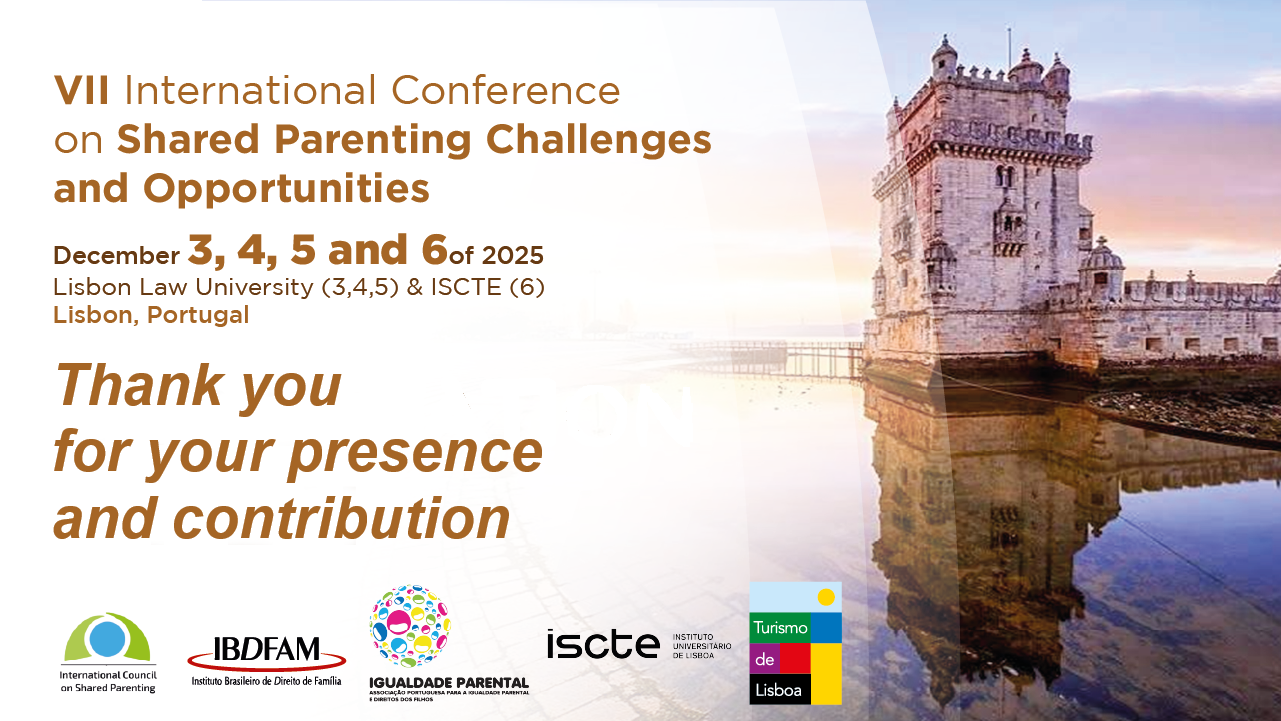
The VII International Council on Shared Parenting (ICSP) Conference was held in Lisbon, Portugal, from 3 to 6 December 2025, in conjunction with the Portuguese Equal Parenting and Children’s Rights Association, Igualdade Parental. Hosted by the University of Lisbon Law School and the University Institute of Lisbon, the conference featured presentations in both English and Portuguese, with simultaneous translation provided for key sessions.
The conference brought together researchers, legal professionals, mental health experts, policymakers and civil society representatives from across the world. In all, 245 participants from 35 countries across five continents were represented, reflecting the growing global relevance of shared parenting research and family justice reform. Building on the legacy of previous ICSP conferences, the Lisbon meeting reaffirmed the Council’s commitment to evidence-based policy, child-centered justice and the promotion of shared parenting as a key protective factor for children’s well-being following parental separation.
The conference took place in a context of significant legal, social and scientific developments, particularly regarding parental alienation, domestic violence and child protection systems. Discussions emphasised the need for nuanced, multidisciplinary and proportionate responses to family conflict, rejecting simplistic or ideologically driven approaches. Importantly, the conference also highlighted the opportunities that shared parenting offers when appropriately supported, including improved child outcomes, reduced inter-parental conflict over time, and more resilient family systems. The conclusions below reflect the main areas of consensus, alongside the challenges and opportunities identified during the conference.
- Legal and Policy Developments in Shared Parenting and Parental Alienation
Participants noted important legislative changes in Brazil and Latin America, particularly the revocation of Brazil’s Parental Alienation Law on 3 December 2025. This revocation was driven largely by concerns about increasing domestic violence cases and the perceived misuse of alienation claims. At the same time, the conference highlighted ongoing legal evolutions in Peru and Ecuador, whose reforms are inspired by earlier Brazilian legislation on parental alienation and shared parenting.
A growing international consensus was observed regarding terminology: there is increasing agreement to move away from framing parental alienation as a ‘syndrome’, while maintaining recognition of alienating behaviours as a real and harmful phenomenon. This shift reflects a broader effort to align legal language with scientific integrity and to avoid pathologising children, while still acknowledging the psychological and relational harm caused by sustained interference in parent–child relationships. Participants stressed that clearer legal definitions and consistent jurisprudence can create opportunities for early intervention, reduce litigation and support cooperative parenting arrangements before conflicts become entrenched.
- Scientific Evidence on Child Development and Parental Conflict
Scientific presentations reaffirmed that rigid triangulation of children in parental conflict exposes them to toxic stress during critical developmental periods. Such stress can significantly compromise children’s emotional regulation, identity formation and self-concept. High-conflict dynamics were repeatedly identified as a central risk factor, regardless of the legal labels attached to the family situation.
The conference reiterated that the strongest body of scientific evidence continues to support equal shared parenting time, when safe and feasible, as the arrangement most consistently associated with positive child outcomes and reduced long-term conflict. Equal shared parenting was presented not as an ideological position, but as a data-driven conclusion emerging from decades of international research.
Alongside this evidence, presenters shared positive practice examples from multiple jurisdictions where shared parenting has led to improved school engagement, stronger parent–child bonds, greater parental accountability and a gradual de-escalation of conflict over time. These examples demonstrated that, when supported by appropriate services and clear expectations, shared parenting can transform adversarial post-separation dynamics into more cooperative and stable family arrangements.
At the same time, participants stressed that shared parenting must be implemented with safeguards, professional assessment and flexibility, particularly in families facing violence, severe dysfunction or multiple compounding challenges.
- Domestic Violence, Child Protection and High-Conflict Families
A central theme of the Lisbon conference was the complex relationship between domestic violence, parental alienation, coercive control and child welfare. The session ‘Children, Families and Domestic Violence’ underscored the difficulty of distinguishing alienating behaviours from protective responses without resorting to a gendered lens.
Speakers emphasised that interventions such as multidisciplinary psychosocial teams, mediation services and child-centered parenting plans can play a critical role in mitigating harm, fostering safer co-parenting, and rebuilding family dynamics. Shared parenting, also referred to as shared residence or joint physical custody, should be limited only when clear evidence demonstrates disinterest, abuse or violence that directly endangers children.
Importantly, examples were shared of jurisdictions where carefully monitored shared parenting arrangements, combined with safety planning and professional oversight, have allowed children to maintain meaningful relationships with both parents while ensuring protection from harm.
A non-gendered, evidence-based approach was strongly supported, highlighting equal accountability for all parents. Proportionality in judicial sanctions was identified as essential to avoid indirectly punishing children through the loss of meaningful relationships or unnecessary financial strain on families.
- Child-Friendly Justice and the Best Interests of the Child
The conference reinforced the principles of child-friendly justice, aligning with the Council of Europe’s recommendations and the findings of GREVIO reports. Participants stressed the need to give greater prominence, in both legal doctrine and jurisprudence, to the emotional harm suffered by children who are victims of parental alienation or prolonged high-conflict disputes.
Conference papers also examined shared parenting in the context of special educational needs and disabilities (SEND). Evidence and practice examples demonstrated that, with coordination and clear communication between parents, schools, and support services, shared parenting can offer children with SEND greater consistency, access to both parents’ skills and resources and improved advocacy across education and health systems.
Importantly, the conference called for measures to end the persistent stigma surrounding men’s parental responsibilities toward very young children and children with additional needs. Such stigma undermines co-responsibility and reinforces outdated caregiving models that are no longer supported by empirical evidence.
- Socioeconomic Inequality and Access to Justice
The presentation on ‘Brazilian Challenges’ illustrated how judicial practices can unintentionally exacerbate maternal overload while failing to promote genuine parental co-responsibility. The continued reliance on a ‘visiting parent’ model was criticised for reinforcing inequality and limiting children’s access to both parents.
Particular concern was expressed regarding low-income families, who face systemic barriers in obtaining judicial approval for shared parenting arrangements with dual residence. Judges and prosecutors often reject these arrangements, citing developmental concerns not supported by current scientific evidence. Participants noted that successful shared parenting initiatives in low-resource settings show that economic disadvantage should not be conflated with parental incapacity. Similar access-to-justice issues were highlighted in other jurisdictions, including administrative failures affecting family support in Poland.
- Extended Family and Intergenerational Alienation
The conference also addressed parental alienation involving grandparents and extended family members. A three-year study revealed that the lack of specific legislation and prior family estrangement are among the main grievances of alienated grandparents. Many experience profound emotional suffering and a sense of helplessness as judicial systems often fail to provide effective remedies.
Positive initiatives from the United States and Europe demonstrated how mediation and legal recognition of extended family roles can help restore intergenerational relationships, benefitting children’s emotional security and sense of identity.
- Innovation, Technology and Systemic Reform
Participants explored how communication technologies can help mitigate parental conflict by structuring and monitoring parental communication. Digital co-parenting platforms and low-threshold interventions were identified as promising tools to reduce escalation, support cooperation and assist parents managing complex arrangements, including those involving children with SEND.
The conference also called for a shift away from high-cost, adversarial legal systems toward more cost-effective coping and prevention programmes. Training for divorce practitioners, early intervention services and integrated support models were presented as sustainable strategies that protect children while reducing long-term societal costs.
- Scientific Integrity and International Cooperation
Finally, the Lisbon conference reaffirmed the central importance of scientific integrity. Participants emphasised that integrity must be coupled with improved communication and cooperation within the scientific community. Ensuring access to reliable data and protecting research from misinformation or distortion were identified as shared ethical responsibilities for researchers, practitioners and policymakers alike.
Final Reflections
The VII ICSP Conference in Lisbon concluded with a strong call for integrated, balanced and child-centered approaches to family separation. Protecting children requires moving beyond polarised debates toward evidence-based policies that safeguard safety, preserve relationships and promote shared parental responsibility.
The conference reaffirmed that shared parenting, when properly supported, offers significant opportunities: stronger child well-being, more resilient families, reduced conflict and fairer distribution of caregiving responsibilities. Supported by robust protection systems, inclusive practices for children with special needs and a commitment to scientific integrity, shared parenting remains a cornerstone for healthier families and more just societies.
Alex Masardo and Sandra Inês Feitor
ICSP Conference Scientific Co-Chairs